welcome to zhenhong steel pipe official website!

Steel Knowledge | Galvanized Round Pipe Grooving Operation Process!
2025-04-27

Hot-Dip Galvanized Round Pipe Product Introduction
“Zhenghong Brand” hot-dip galvanized round pipes (hereinafter referred to as “galvanized round pipes”) are standardly named “Hot-Dip Galvanized Welded Steel Pipes for Low-Pressure Fluid Conveying”. They are produced by hot-dip galvanizing the inner and outer surfaces of welded steel pipes, resulting in a zinc layer on both the inner and outer walls, significantly improving the pipe's corrosion resistance—approximately 20 times that of ordinary steel pipes. Galvanized round pipes, used as conveying pipelines or metal structures, are widely used in fire protection engineering, natural gas transmission, petroleum processing industries, water conservancy projects, and residential construction.
Purpose of Grooving Hot-Dip Galvanized Round Pipes
Grooving is a process of machining grooves onto the surface of pipe materials. The main purpose of grooving galvanized round pipes is to increase connection strength and ensure the sealing and reliability of the pipeline system. In fire protection, water supply and drainage, and HVAC engineering fields, galvanized round pipes, after grooving and connection, can form a more robust and stable pipeline system, meeting usage requirements in various complex environments.
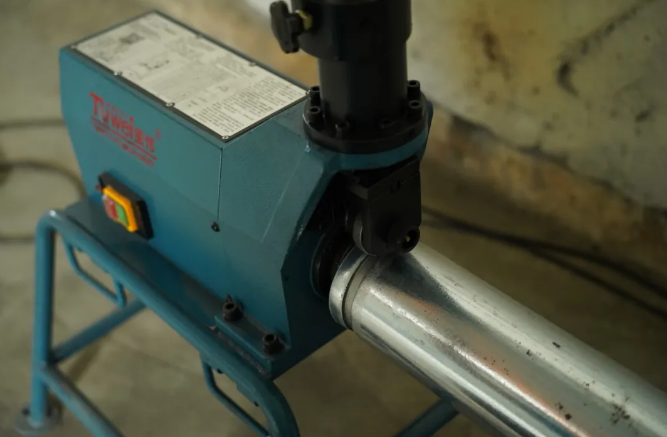
Grooving Operation of Hot-Dip Galvanized Round Pipes
01
Preparation Stage
• Carefully select galvanized round pipes to ensure the material meets project requirements.
• Use a cutting machine to cut the galvanized round pipes to the required length, ensuring that the cut is flat and burr-free. Smooth the inner weld of the welded pipe to ensure a smooth weld.
02
Inspection Stage
Conduct a thorough inspection of the pipe material to confirm the absence of quality defects before proceeding to the next step.
03
Equipment Adjustment
• Adjust the grooving equipment according to the pipe material specifications to ensure the equipment is in optimal working condition.
• Check if there is sufficient hydraulic oil; ensure that the machine cannot operate without oil.
04
Grooving Steps
① Place the support according to the length of the steel pipe, place one end of the steel pipe on the knurling wheel, and the other end on the support.
② The support should be placed at 2/3 of the total length of the steel pipe away from the rolling groove end. Adjust the height of the support so that both ends of the steel pipe are level or the support end is slightly lower, ensuring stable rolling of the steel pipe.
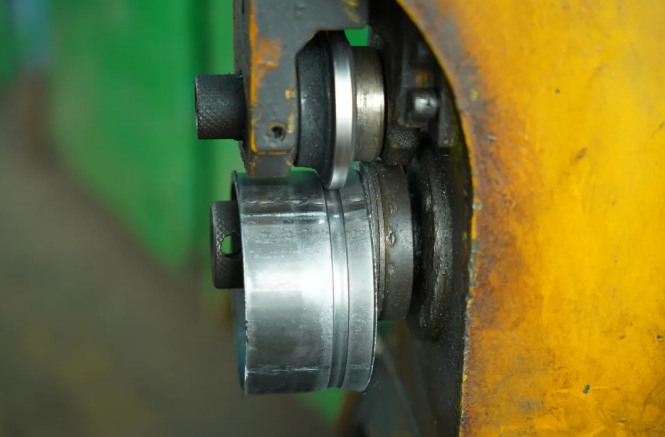
③ Tighten the pressure relief valve, press down the handle to make the pressure wheel contact the steel pipe surface, rotate the limit nut to contact the oil pump surface, check the groove depth gauge, and rotate upwards to the corresponding scale.
④ Then rotate the locking nut downwards and tighten the locking nut. The distance between the limit nut and the oil pump surface is the groove depth.
⑤ Plug in the power, start the rolling machine, and slowly rotate the oil pump handle. After rolling to the required size, rotate the steel pipe one to two more turns to ensure the groove is complete, then turn off the switch. (At the beginning, we should try to control the force, lightly press to make the rolling groove contact the steel pipe by about 1 millimeter, rotate evenly for two turns, and let the steel pipe preheat before slowly pressing down.)
⑥ Stop the machine and measure the depth and width of the groove with a vernier caliper. After confirming that the groove size meets the requirements, unload the rolling machine and remove the steel pipe.
This concludes the grooving tutorial, but Zhenghong's pursuit of quality never stops. We always engrave “craftsmanship” into every steel pipe. We thank every customer for their support; it is you who make Zhenghong's story warmer. In the future, we look forward to working with you to build more “steel legends”!
Previous:
Service Hotline in South China:400-888-5765
Service Hotline Southwest:400-999-8393


Contact Information
South China:400-888-5765
Southwest:400-999-8393
Facilities
Foshan Sanshui Zhenhong Steel Products Co., Ltd.
Address: Fanhu Economic Development Zone, Liping Town, Sanshui District, Foshan City
Guangdong Zhenxiong Steel Pipe Co., Ltd.
Address: Waisha Industrial Zone, Village Wei Village, Nanzhuang Town, Chancheng District, Foshan City
Guangzhou Huadu District Zhenhong Steel Pipe Factory
Address: Chatang Industrial Zone, Tanbu Town, Huadu District, Guangzhou (beside Zen Tan Road)
Sichuan Zhenhong Steel Products Co., Ltd.
Address: Chaoyang Avenue, Economic Development Zone (North District), Shifang City, Sichuan Province
Follow us in Wechat
Zhenhong Official Account
Copyright©2024 Foshan Sanshui Zhenhong Steel Products Co., Ltd. All Rights Reserved Powered by 300.cn SEO Tags Privacy